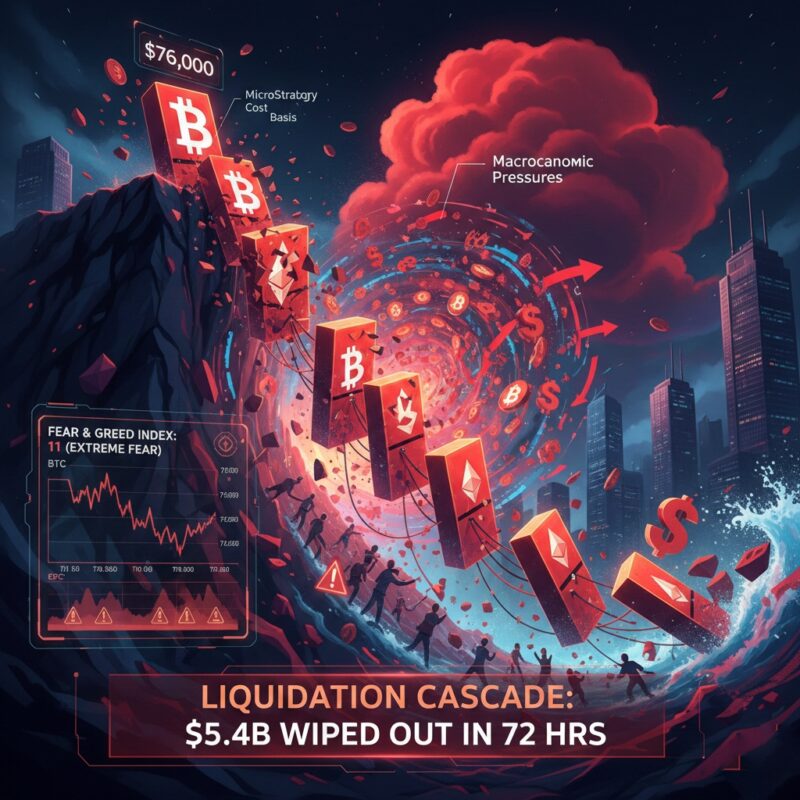
The cryptocurrency market is currently reeling from a violent deleveraging event. Over the past 72 hours, more than $5.4 billion in leveraged positions have been vaporized, sending Bitcoin below the psychological $70,000 support level for the first time since late 2024.
For many retail investors, this crash felt like it happened “all at once.” That’s because it did. What we are witnessing is a Liquidation Cascade—a mechanical phenomenon where the market’s own safety protocols become the fuel for its downfall.
What is a Liquidation Cascade?
In a standard stock market, if a price drops, buyers usually step in to “buy the dip.” In a crypto liquidation cascade, the selling is automated.
When traders use “leverage” (borrowed money) to bet on prices going up, they must maintain a minimum amount of collateral. If the price of Bitcoin hits a certain “Liquidation Price,” the exchange’s engine automatically sells their position at market price to protect the lender.
Why Today Was Different: The $5.4 Billion Tsunami
Today’s wipeout was particularly brutal due to a “perfect storm” of factors:
- Thin Liquidity: As risk-off sentiment grew due to tech sell-offs in Asia and the U.S., there were fewer “limit buy” orders sitting on the books to absorb the cascade.
- The $70,000 Trap: A massive cluster of stop-losses and liquidation levels sat between $71,000 and $69,000. Once the $71,000 “dam” broke, the resulting “wall of fire” wiped out $775 million in leverage in a single four-hour window.
- Crowded Trades: Open interest (the total number of outstanding derivative contracts) had ballooned to unsustainable levels during the late 2025 rally. The market was “top-heavy” and waiting for a reason to tip.
As of today, Bitcoin’s drop to $69,100 finally allowed for a “leverage reset,” meaning the investors left in the market are largely those holding the actual asset (spot), rather than those gambling on credit.
Expert Take: “The ‘up-only’ narrative has been fractured, but the structural integrity remains. We have moved from a market driven by greed to one driven by defensive accumulation.”